STD Testing in Koh Phi Phi
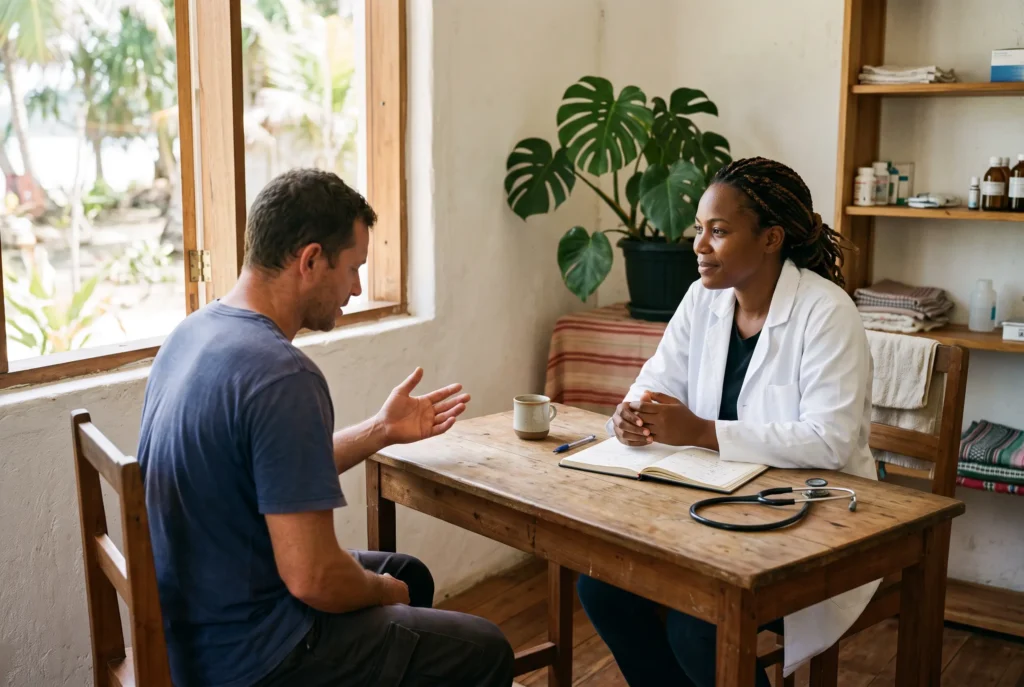
Sexual health testing on a small island raises an obvious worry, so it is worth answering first: nobody here knows who you are, nothing is shared with your hotel or the people you are travelling with, and the result goes to you alone. STD testing in Koh Phi Phi is discreet, available at any hour, and considerably easier than the version of this conversation you are imagining.
What we test for
The standard screen covers the infections that actually matter for travellers:
- HIV — rapid test with a result in about twenty minutes
- Syphilis — blood test
- Chlamydia — urine sample, or a swab
- Gonorrhoea — urine sample, or a swab
- Hepatitis B and C — blood test
- Herpes — blood test, or a swab if there is a visible sore
You can have the full panel or only what concerns you. We will tell you what is worth including based on what happened rather than defaulting to the longest list.
Timing, which is the part people get wrong
Every test has a window period — the gap between exposure and the point the test can detect anything. Testing inside that window produces a negative result that means nothing, and a great deal of unnecessary distress follows from not knowing this.
Chlamydia and gonorrhoea are detectable from about one to two weeks. HIV, with a modern fourth-generation test, is reliable from about four weeks and conclusive at six to twelve. Syphilis takes three to six weeks. Hepatitis C can take up to twelve.
So if the exposure was two nights ago, testing today tells you about your status before it, not after. That is still useful information, and we will explain what to test now and when to come back — see HIV testing.
If it was very recent, the clock is different
If you think you were exposed to HIV within the last 72 hours, this is not a testing conversation — it is a treatment one, and it is urgent.
PEP is a month-long course of medication that can prevent HIV from establishing itself, and it works best the sooner it starts. After 72 hours it is no longer offered. See PEP and PrEP and come in now rather than waiting to see how you feel.
This is where being open all night genuinely matters. On an island where the last ferry has gone by early evening, a clinic that shuts would mean losing eight or ten hours of a seventy-two hour window to nothing but waiting.
Symptoms worth coming in for
Many sexually transmitted infections have no symptoms at all, which is exactly why testing exists. But come in without waiting for a test window if you have:
- Discharge from the penis or a change in vaginal discharge
- Pain or burning when passing urine
- Sores, ulcers, blisters or lumps in the genital area
- Unusual bleeding between periods or after sex
- Pain in the testicles or lower abdomen
- A rash on the palms or soles, which can indicate syphilis
Burning on urination is worth flagging: it is often a straightforward urinary tract infection rather than anything sexually transmitted, and the two are told apart with a simple urine test.
How discreet it actually is
You are seen like any other patient, and no reason for the visit is announced anywhere. Results go to you directly and are not sent to your hotel, your insurer without your consent, your embassy, or anyone travelling with you.
If you would rather the receipt did not itemise a sexual health screen, say so and we will describe it as a consultation and blood tests, which is accurate.
Testing is not reported to Thai immigration and has no bearing on your visa. That question comes up often enough to be worth answering plainly.
Nobody here is interested in the circumstances either. The questions you are asked — what happened, roughly when, whether there are symptoms — exist solely to decide which tests are worth running and when they will be reliable.
Getting a result, and what happens next
Rapid HIV results come back in about twenty minutes while you wait. Most other results take one to three days, and we contact you however you prefer — a message, a call, or coming back in.
A positive result for chlamydia or gonorrhoea means treatment here, usually a single antibiotic dose or a short course, and it is straightforward. Syphilis is treated with injections. Both are entirely curable.
A reactive HIV result on a rapid test always needs a confirmatory laboratory test before it means anything, and we arrange that immediately rather than leaving you holding an unconfirmed result over a weekend on an island.
Partners, and the awkward second conversation
If you test positive for something curable, your recent partners need to know, or you will simply be reinfected by the same person a fortnight later. That is the practical argument and it usually lands better than the moral one.
We can give you a written summary describing what was found and what treatment is needed, which is often easier to send than to explain — particularly across a language barrier, and particularly to somebody who has already left the island.
Avoid sex until treatment is complete and, for most infections, for a further week afterwards. We will tell you the exact interval for what you were treated for.
Condoms bought on the island are worth a second look, incidentally. A packet that has spent a season in a hot glass cabinet in direct sun has often been kept well above the temperature latex is rated for, and heat degrades it. Check the expiry date, buy from a pharmacy or a shop that keeps stock out of the sun, and do not store them in a pocket or a bag left on the beach all afternoon.
Frequently asked questions
Is it confidential?
Yes. Results go to you alone and nothing is shared with your hotel, your travel companions or Thai immigration.
How soon after exposure can I test?
It depends on the infection — roughly one to two weeks for chlamydia and gonorrhoea, four weeks for HIV, three to six for syphilis. We will tell you what to test now and when to return.
How long do results take?
Rapid HIV is about twenty minutes. Most other results take one to three days.
Do I need an appointment?
No. Walk in at any hour like any other patient.
How much does testing cost?
It depends which tests you have, and you are quoted before anything is taken. You can test for one thing rather than the whole panel.
What if I was exposed to HIV two nights ago?
Come in now. That is a PEP conversation, not a testing one, and PEP is not offered beyond 72 hours.
Will this affect my visa?
No. Testing here is not reported to immigration and has no bearing on your visa.
Who treats you, and at what hour
English-speaking doctors on site, 24 hours a day. That is the part worth dwelling on, because Koh Phi Phi has no hospital and no road off it. The nearest emergency department is a ferry away on the mainland, and the ferries stop at night — so between roughly sunset and morning, a clinic that is actually open is the only medical care on the island. We are part of the Takecare Clinic group operating across Krabi and Phuket, which is what makes onward referral and continuing treatment on the mainland straightforward rather than something you arrange yourself from a hotel room.
Getting seen
Doctor Phi Phi Takecare Clinic is 24 hours, every day — genuinely, not as a phone line. No appointment is needed at any point and there is no wrong time to turn up. Walk in, or reach us on +66 82 140 3858 or WhatsApp. If you would rather not move, ask for a doctor hotel visit and we will come to you. And if this turns out to be beyond what the island can handle, that same call is how the ferry and the hospital transfer start being arranged — which on Phi Phi is a process worth starting early rather than late.