Skin rash treatment in Koh Phi Phi
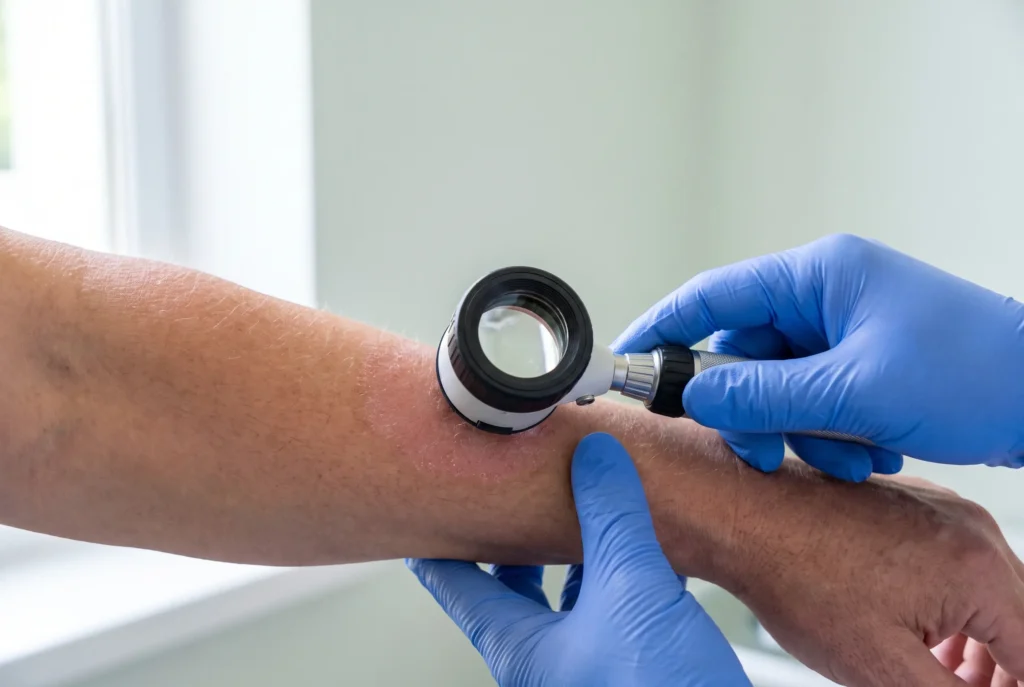
Heat, humidity, salt, sun, sweat under a wetsuit and a room that never quite dries out — this island is hard on skin, and rashes are one of the most common things we see. Skin rash treatment in Koh Phi Phi starts with identifying which of the handful of usual suspects this is, because heat rash, fungal infection and an allergic reaction all look red and all need different treatment.
Heat rash, which is the commonest
Tiny red bumps or clear blisters, prickling or stinging rather than itching, appearing where clothing sits or where skin touches skin — waistband, bra line, the backs of knees, and anywhere a wetsuit presses.
It is blocked sweat ducts rather than an infection. The sweat cannot get out, so it sits under the skin and irritates it. Nothing you apply fixes that; what fixes it is letting the skin cool and dry.
Loose cotton, time out of the sun, cool showers without soap on the affected area, and a few hours in air conditioning. Thick creams make it worse by blocking the ducts further. It settles in a few days once the skin gets a break.
Fungal rashes, which is the second commonest
Warm, damp, covered skin is ideal for fungus, and this climate provides all three continuously.
Ringworm appears as a red ring with a clearer centre and a scaly edge. Jock itch affects the groin with a well-defined border. Athlete’s foot sits between the toes, which spend the day damp in flip-flops. Tinea versicolor produces pale or darker patches on the chest and back that people usually notice as uneven tanning.
All respond to antifungal creams, but they need using for one to two weeks beyond the point the rash looks gone. Stopping when it looks better is the single commonest reason these come straight back.
Wetsuits deserve a mention. A rental suit worn by somebody else that morning, rinsed in a communal tank and still damp, is an efficient way to acquire a fungal rash across the trunk.
Allergic and contact reactions
Hives — raised, intensely itchy welts that move around and change shape within hours — point to an allergic reaction. Food, medication and insect bites are the usual triggers.
Contact dermatitis stays where the trigger touched: a rectangle where a plaster was, a band where a watch strap sits, a stripe where sunscreen ran. Here it is frequently sunscreen, a new insect repellent, or the detergent a guesthouse uses.
Some plants cause a reaction that only appears in sunlight, producing odd streaky burns hours after a walk. It looks alarming and is usually harmless.
Sea and sun rashes
Sea bather’s eruption is an itchy rash under swimwear, caused by tiny jellyfish larvae trapped against skin. It appears within hours of swimming and itches badly. Rinse in salt water rather than fresh, remove the swimwear immediately, and wash it hot — larvae in the fabric will sting again next time it is worn.
Sea lice and coral irritation cause similar patterns. A jellyfish sting looks different, with linear welts tracing where a tentacle touched.
Polymorphic light eruption is a rash on skin newly exposed to strong sun, usually chest and forearms, in the first days of a trip. It settles as the skin acclimatises and responds to sun avoidance and antihistamines. See sunburn treatment for the burn side of things.
The rashes that mean come in now
Most rashes are irritating and harmless. These are not:
- A rash that does not fade when pressed with a glass
- Rash with high fever, particularly with headache or neck stiffness
- Rapidly spreading redness that is hot and painful — that is cellulitis
- Blistering with skin peeling in sheets
- Any rash involving the eyes, mouth or genitals
- Rash with facial swelling or difficulty breathing
The non-blanching rash is the one to know. Press a clear glass against it — if the spots stay visible through the glass rather than fading, that needs immediate attention, at any hour.
What we do at the clinic
Most rashes are diagnosed by looking, with a few questions about timing, what is new, and where it started. Where fungal infection is uncertain, a skin scraping settles it.
Treatment follows the diagnosis rather than a general anti-rash approach: antifungals for fungal, steroid creams for inflammatory and allergic, antihistamines for hives, antibiotics only where there is genuine bacterial infection.
Steroid cream on a fungal rash is a specific trap worth naming. It reduces the redness for a few days while letting the fungus spread underneath, producing a rash larger and harder to treat than it started. Combination creams sold over the counter cause this regularly.
Keeping skin intact on this island
Shower after every swim and dry properly, particularly between toes and in skin folds. Change out of wet swimwear rather than letting it dry on you, and rinse a rental wetsuit before you put it on rather than only after.
Loose cotton beats synthetics. Powder in skin folds helps.
Scratching is the part people underestimate. A fungal or heat rash is not dangerous, but fingernails carrying sand and salt break the surface and introduce bacteria, and a good proportion of the infected skin we treat started as something harmless scratched raw overnight. Keep nails short, treat the itch properly rather than enduring it, and see wound dressing if a rash starts weeping or crusting.
Frequently asked questions
What is the most common rash here?
Heat rash, followed by fungal infections. Both are driven by warm damp skin rather than anything you caught.
Why does my rash keep coming back?
Usually a fungal rash treated for too short a time. Keep using the cream for one to two weeks after it looks gone.
Can I use a steroid cream?
Not on a fungal rash — it makes it spread while masking the redness. Get the diagnosis first.
I have an itchy rash under my swimsuit. What is it?
Probably sea bather’s eruption from jellyfish larvae trapped against the skin. Rinse in salt water, remove the swimwear, and wash it hot.
Could my wetsuit be causing it?
Quite possibly. A rental suit worn by somebody else that morning and still damp is an efficient way to pick up a fungal rash across the trunk.
When is a rash an emergency?
If it does not fade under pressure, comes with high fever or neck stiffness, involves facial swelling or breathing difficulty, or is spreading rapidly and hot.
Can I still swim?
For heat and fungal rashes, salt water is not harmful but staying damp afterwards is. Dry thoroughly. For anything broken or weeping, stay out.
Who treats you, and at what hour
English-speaking doctors on site, 24 hours a day. That is the part worth dwelling on, because Koh Phi Phi has no hospital and no road off it. The nearest emergency department is a ferry away on the mainland, and the ferries stop at night — so between roughly sunset and morning, a clinic that is actually open is the only medical care on the island. We are part of the Takecare Clinic group operating across Krabi and Phuket, which is what makes onward referral and continuing treatment on the mainland straightforward rather than something you arrange yourself from a hotel room.
Getting seen
Doctor Phi Phi Takecare Clinic is 24 hours, every day — genuinely, not as a phone line. No appointment is needed at any point and there is no wrong time to turn up. Walk in, or reach us on +66 82 140 3858 or WhatsApp. If you would rather not move, ask for a doctor hotel visit and we will come to you. And if this turns out to be beyond what the island can handle, that same call is how the ferry and the hospital transfer start being arranged — which on Phi Phi is a process worth starting early rather than late.