IV Drip Therapy in Koh Phi Phi
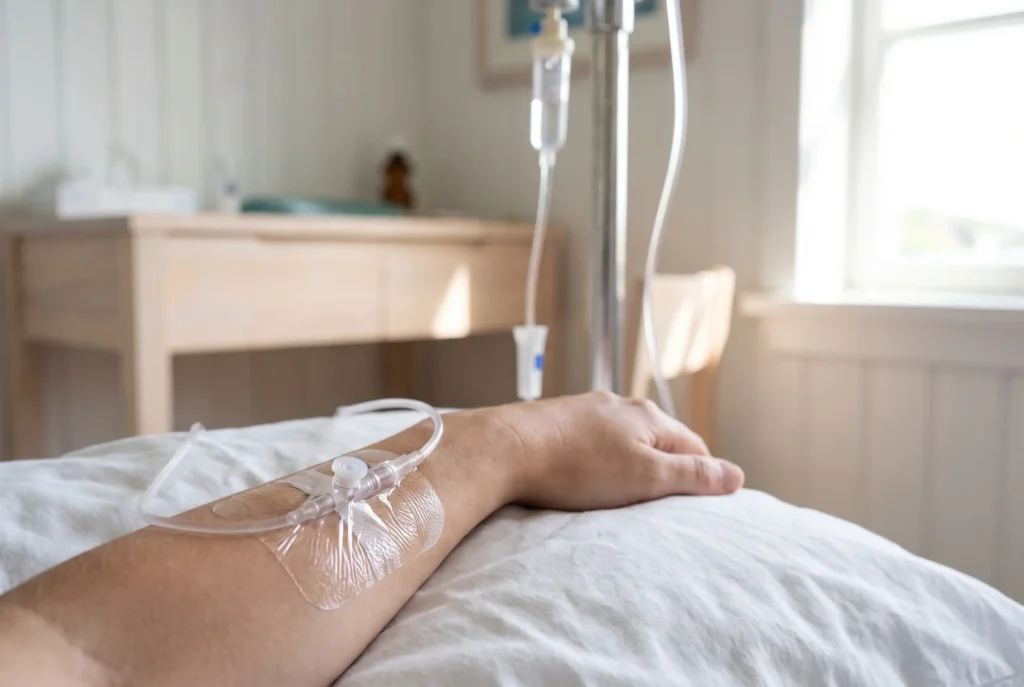
When somebody cannot keep water down, drinking more is not the answer — it comes straight back up while the dehydration deepens. An IV drip in Koh Phi Phi puts fluid and salts directly into the bloodstream, bypassing a stomach that has stopped cooperating, and the difference is usually obvious inside an hour. We can do it at any time of day or night.
Why a drip beats drinking, when it does
Oral rehydration is the right first move for most people and works perfectly well for mild dehydration. The drip earns its place at the point the stomach has stopped being a viable route.
That means persistent vomiting, diarrhoea losing fluid faster than you can replace it, or dehydration deep enough that drinking would take many hours to correct. An intravenous litre works in about forty minutes and does not depend on anyone keeping anything down.
It also lets anti-nausea medication go in directly, which frequently breaks the cycle — once the vomiting stops, ordinary drinking becomes possible again and the drip has done its job.
What we use them for on this island
The morning after, by a very wide margin. Phi Phi runs on buckets, buckets are stronger than they taste, and the resulting dehydration is genuine rather than self-inflicted whining — a night of vomiting in thirty-degree heat leaves people properly unwell.
Then food poisoning and stomach infections, heat exhaustion from the viewpoint climb, and dengue and other high fevers where fluid requirements rise sharply.
Divers are a specific case. A full day of diving is dehydrating in ways people do not register — dry compressed air, sun on the boat, and a reluctance to drink because getting out of a wetsuit is a nuisance. Dehydration also raises decompression risk, which makes it a safety matter rather than a comfort one.
What actually goes in
The base is a balanced salt solution — normal saline or Ringer’s lactate — chosen for what has been lost. Sweat and vomit remove sodium and other electrolytes, not just water, which is why replacing losses with plain water alone can leave somebody feeling worse rather than better.
To that we add what the situation needs: anti-nausea medication, pain relief, or antibiotics where an infection warrants intravenous treatment.
Vitamin additions are available and are the most frequently requested part. We will give you them and also tell you the truth about them: they are a comfort measure, and the salt and water do the actual work.
How long it takes and how it feels
A litre runs in roughly thirty to forty-five minutes. Most people need one or two, so allow one to two hours in total.
The cannula going in is a sharp scratch and then nothing. The fluid can feel cool travelling up the arm, which is normal and passes. Bring a phone charger; there is not much to do.
People usually notice the shift somewhere in the second half of the first bag — the headache lifting, the nausea receding, the ability to sit up without the room moving. It is one of the more satisfying things to watch, and it is why the treatment is popular well beyond its strict indications.
Checks we run first, and why they matter
Blood pressure, pulse, temperature and oxygen saturation before anything is set up, and an assessment of how dehydrated you actually are rather than how dehydrated you feel.
Where the picture warrants it we run blood tests for kidney function and electrolytes. Somebody who looks merely tired after a heavy night and a hot day can have genuinely deranged bloods, and knowing that changes what goes into the bag.
That check is also how we catch the thing that is not simple dehydration. Persistent vomiting occasionally signals something surgical, a fever with it may be dengue rather than a bad meal, and repeated vomiting after a head injury is a different problem entirely. A drip that makes somebody comfortable without anyone asking why they are ill is a missed diagnosis waiting to happen.
Who should not simply be handed one
Anyone with significant heart or kidney disease needs a considered decision rather than a routine litre, because volume that helps a healthy traveller can overload a compromised heart.
The same caution applies to older patients and anyone on diuretics. None of that rules a drip out; it means the rate and volume are chosen deliberately, and that we ask about your history rather than treating the request as an order.
And if the honest answer is that you are mildly dehydrated and would do just as well with an hour in the shade and some rehydration salts, we will say so rather than sell you a bag.
Coming in, or us coming to you
Most people come in, and at three in the morning that is usually the faster option since the clinic is staffed anyway.
A drip can also be set up in your room as part of a doctor hotel visit, which suits anyone too unwell to walk. On an island where every journey is on foot through sand and alleys, that is a real consideration rather than laziness.
Either way you are told the cost before it starts, and you leave with an itemised receipt and an English medical report for your insurer.
Frequently asked questions
How much does an IV drip cost?
It depends on the fluid and any medication added, and you are quoted the full price before anything is set up.
How long does it take?
About thirty to forty-five minutes per litre. Most people have one or two bags, so allow one to two hours.
Does it hurt?
A sharp scratch as the cannula goes in, then nothing. The fluid can feel cool travelling up the arm.
Can I have one just for a hangover?
Yes, and it is our commonest reason for setting one up. We check you over first, because occasionally what looks like a hangover is heat illness or the start of a fever.
Will a vitamin drip cure my cold?
No. Vitamins are a comfort addition; the fluid and electrolytes do the work. We would rather say that than sell you the idea.
Can I dive after a drip?
Being properly hydrated is better for diving than being dehydrated, but if you needed a drip because you were ill, that illness is the reason to skip the dive. Ask us.
Can you do it at my hotel at 4am?
Yes, as part of a doctor hotel visit. Late-night visits cost more than coming in, and you are told the price when you call.
Who treats you, and at what hour
English-speaking doctors on site, 24 hours a day. That is the part worth dwelling on, because Koh Phi Phi has no hospital and no road off it. The nearest emergency department is a ferry away on the mainland, and the ferries stop at night — so between roughly sunset and morning, a clinic that is actually open is the only medical care on the island. We are part of the Takecare Clinic group operating across Krabi and Phuket, which is what makes onward referral and continuing treatment on the mainland straightforward rather than something you arrange yourself from a hotel room.
Getting seen
Doctor Phi Phi Takecare Clinic is 24 hours, every day — genuinely, not as a phone line. No appointment is needed at any point and there is no wrong time to turn up. Walk in, or reach us on +66 82 140 3858 or WhatsApp. If you would rather not move, ask for a doctor hotel visit and we will come to you. And if this turns out to be beyond what the island can handle, that same call is how the ferry and the hospital transfer start being arranged — which on Phi Phi is a process worth starting early rather than late.